
超润滑硬质阳极氧化工艺及药水研发 英文版 报告
SURFACE TREATMENT TECHNICAL REPORT
Ultra-Lubricating Hard Anodizing
Kashima Coat: Process Preparation & Electrolyte Selection
Two-step electrolysis: porous hard anodizing + in-pore precipitation of molybdenum disulfide (MoS2)
Prepared: 2026-08-28
JUSCO-CHEM 佳士克(中国)
Application: wear-resistant & self-lubricating surface treatment for sliding components
Contents
Important Clarification: Technology Ownership
1. Overall Process Route
2. Step-1 Electrolysis: Hard Anodizing Electrolyte Selection
3. Step-2 Electrolysis: MoS2 Precipitation (Lubricant Introduction)
4. Material (Aluminum Alloy) Selection
5. Performance Comparison
6. Quality Control & Failure Points
References
Important Clarification: Technology Ownership
Kashima Coat was NOT developed by "Miyaki Electric Mfg. Co., Ltd. (MIYAKI ELECTRIC MFG.)" mentioned in the previous report. Both companies share the same kanji "宮木" and both read "MIYAKI (ミヤキ)", but they are two entirely different companies:
• Miyaki Electric Mfg. Co., Ltd. (MIYAKI ELECTRIC MFG., Kameoka, Kyoto, founded 1918):manufacturer of explosion-proof electrical equipment, switchboards, and control equipment
• MIYAKI Co., Ltd. (Hamamatsu, Shizuoka, established 1981):specialist in aluminum anodizing surface treatment - the developer of Kashima Coat
1. Overall Process Route
The officially disclosed process is a two-step electrolysis method, not simple surface coating:
• Step-1 electrolysis:forms a porous hard anodized (Al2O3) film with tens of billions to 70 billion regularly arranged nano-scale vertical micropores per cm2 - the source of "hardness" (HV400)
• Step-2 electrolysis:MoS2 is refined and precipitated/electrophoresed from the pore bottom upward to fill the pores to the set film thickness - the source of "lubricity"
Key breakthrough: traditional approaches (PTFE, graphite, MoS2, WS2 applied with organic binders and baked) fail because particle sizes (min ~0.3 μm) far exceed the anodic pore diameter, so the lubricant only sits on the surface and easily peels. Kashima Coat's core is refining MoS2 to enter the nanopores and precipitating it "from the base" inside the pores, embedding the lubricant in the film so it does not wash away.
Patent note: This process is protected by MIYAKI patents (14 domestic patents, trademark registered in 38 countries, exclusive partnership with FOX for bicycle suspension). Below is a generic framework and electrolyte selection guideline reproducible from this principle; proprietary recipes are not disclosed - conduct patent search and licensing assessment before mass production.
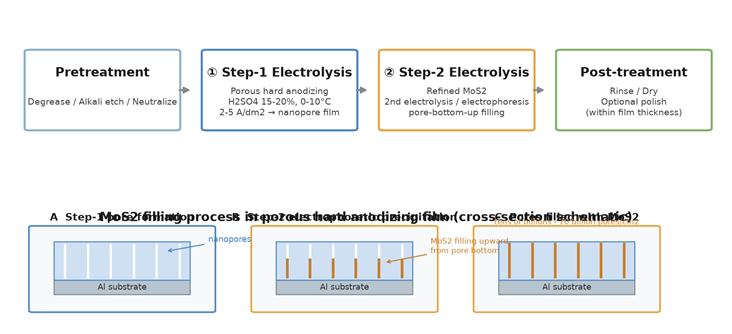
Fig. 1 Kashima Coat process flow: Pretreatment → Step-1 anodizing (pore formation) → Step-2 MoS2 precipitation & fill → Post-treatment; bottom: three-stage cross-section schematic
2. Step-1 Electrolysis: Hard Anodizing Electrolyte Selection
This is the foundation of the process, determining pore density, depth, and film hardness.
Table 1 Step-1 hard anodizing electrolyte & process parameter selection
|
Item |
Selection Range |
Remarks |
|
Primary acid |
Sulfuric acid (H2SO4) 15-20 wt% (10-30% possible) |
Most mature hard anodizing bath; high pore density, controllable pore size |
|
Additives |
Oxalic acid 1-2%, tartaric acid, sulfosalicylic acid, etc. |
Combined with sulfuric acid: suppresses dissolution, denser film, higher hardness, less burning |
|
Bath temp. |
0-10°C (down to -5 to +5°C for harder films) |
Requires chiller + strong agitation; high temperature dissolves the film (powdering/burning) |
|
Current density |
2-5 A/dm2 |
2-5× that of standard anodizing; ramp current per alloy |
|
Voltage |
25-120 V, rises as film thickens |
Standard anodizing <18 V; hard anodizing much higher; allow rectifier headroom |
|
Time |
45-120 min |
Thickness ≈ current density × time; target 25-100 μm |
|
Cathode |
Lead plate or graphite |
Lead common; watch oxide film conductivity |
|
Agitation/cooling |
Air agitation + forced circulation + heat exchanger |
High current generates large Joule heat; strong cooling required |
Selection experience: for high hardness & thick films use a "sulfuric + oxalic" composite bath; 5000/6000 series aluminum gives better uniformity; hard-to-treat alloys containing copper (2000 series) or high-silicon die-cast (ADC12/A380) need special processes (MIYAKI has a separate MD process for die-cast parts).
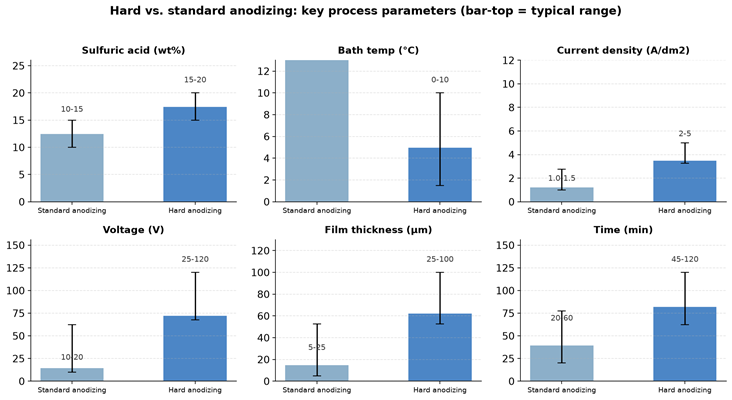
Fig. 2 Hard anodizing vs. standard anodizing: key process parameter comparison (values above bars = typical ranges)
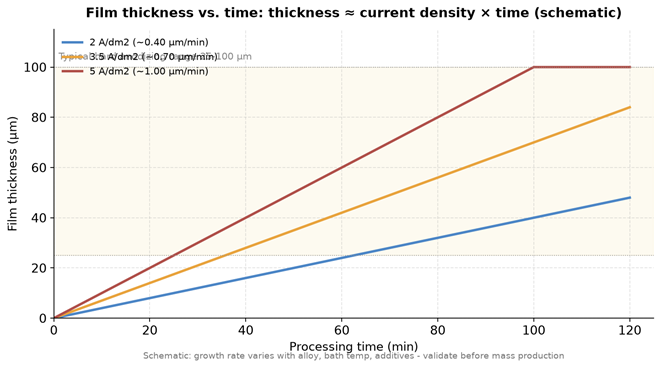
Fig. 3 Film thickness vs. processing time (schematic): thickness ≈ current density × time
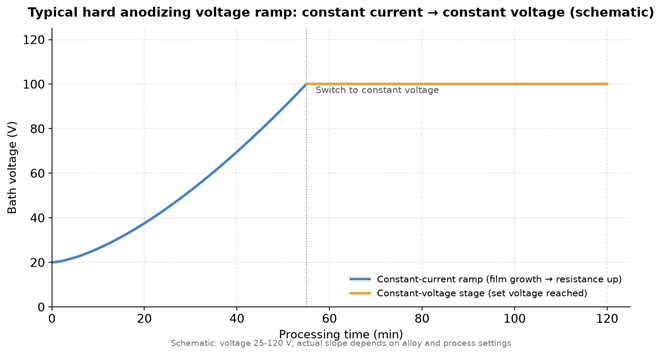
Fig. 4 Typical hard anodizing voltage ramp: constant current → constant voltage (schematic)
3. Step-2 Electrolysis: MoS2 Precipitation (Lubricant Introduction)
This is the core step of "ultra-lubrication" and the most difficult part.
Prerequisite: MoS2 must be nano-refined to enter the anodic micropores (typically a few to tens of nanometers). Available precursor systems:
• Molybdate + sulfur-source system:sodium molybdate (Na2MoO4) or ammonium molybdate + excess S2- source (ammonium tetrathiomolybdate (NH4)2MoS4, sodium sulfide, etc.), forming thiomolybdate ions in an alkaline/weakly alkaline electrolyte, then electrochemically reduced to precipitate MoS2 inside the pores
• Electrophoretic deposition route:MoS2 nanoparticle dispersion + charged dispersant; the secondary electric field electrophoreses particles into the pores and deposits them
Step-2 parameter points: use low-current / controlled-potential to deposit MoS2 preferentially from the pore bottom rather than plugging the mouth; keep bath temperature and pH stable; repeat cycles to fill the film thickness.
4. Material (Aluminum Alloy) Selection
Table 2 Aluminum alloy material selection
|
Suitability |
Alloy |
Remarks |
|
Excellent |
1000-series pure Al, 5000-series (5052, etc.), 6000-series (6061/6063, etc.) |
Uniform film, regular pore structure; best for Kashima Coat-type treatment |
|
Fair |
7000-series (7075, etc.) |
Treatable; darker film; adjust parameters |
|
Difficult |
2000-series (2024 Cu-bearing), high-silicon die-cast (ADC12/A380) |
Cu/Si-rich phases cause uneven, low-hardness films; die-cast needs special MD process |
|
Avoid |
High-zinc/magnesium castings, etc. |
Poor film formation, easy burning |
Post-processing: within the film thickness, grinding/polishing (lapping/polishing) can restore high-precision sliding surfaces - a reason it suits precision sliding parts.
5. Performance Comparison

Fig. 5 Wear resistance comparison: Kashima Coat ≈ 4× hard anodizing, 3× hard chromium plating (relative wear index, hard anodizing = 1)
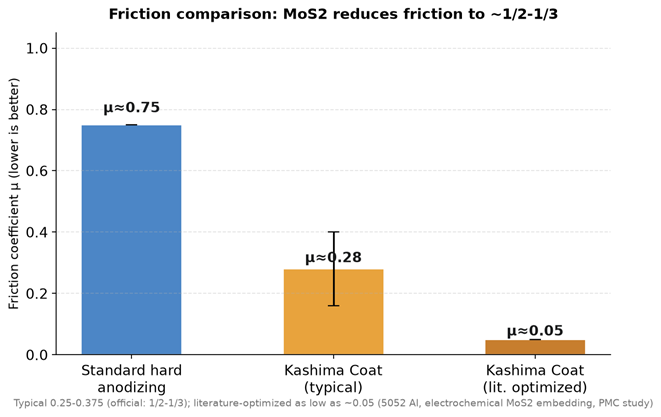
Fig. 6 Friction coefficient comparison: MoS2 reduces friction to about 1/2-1/3
• Hardness:HV400 ceramic-grade hardness; hundreds of billions to 70 billion micropores per cm2
• Wear resistance:~3× hard chromium plating, ~4× hard anodizing in reciprocating sliding durability tests; durability ~3-5× ordinary hard anodizing
• Low friction:MoS2 reduces friction coefficient ~50-70% (to 1/2-1/3), preventing seizure, galling, and scuffing
• Additional advantages:post-polishing/grinding for high-precision sliding parts; thermal stability for high-performance engine components; oil-free (dry) sliding capability
6. Quality Control & Failure Points
• Distinguishing genuine vs. fake:genuine Kashima Coat shows a brownish hue from Mo impregnation; its essence is film structure + internal MoS2 precipitation. Color-only imitations (surface coating/dyeing) differ completely in friction coefficient, wear life, low-temperature performance, and seizure resistance - in transport/industrial equipment the difference can cause serious accidents
• High-temperature limit:MoS2 itself is heat-resistant, but above ~100°C in sliding service, thermal expansion mismatch between the Al substrate and alumina film creates thermal stress that may induce microcracks - for high-temp parts, evaluate film thickness, part geometry, and temperature cycling
• Batch stability:pore density (tens of billions to 70 billion/cm2) and MoS2 fill depth are core QC items; recommended acceptance via EPMA cross-section observation + reciprocating sliding wear test (e.g., HEIDON-type surface tester, 500 g load)
References
MIYAKI Co., Ltd. official product page: Kashima Coat technical characteristics and wear/friction data (www.jusco-chem.com)
MIYAKI Co., Ltd. company profile & history (news.kashima-coat.com/about/outline.html)
MIYAKI Laboratory technical columns: MoS2 precipitation mechanism, film structure, high-temperature notes (magazine.miyaki.website)
Generic hard anodizing process parameters: MISUMI technical data, HEIDON test conditions, etc.
Academic literature: electrochemical incorporation of MoS2 into AAO (PMC10934346, 5052 aluminum)
Note: Figs. 3/4 are schematic; in Fig. 5 "standard anodizing" is an approximate value for order-of-magnitude reference only.